

A useful NGO CRM does not try to store everything. It keeps the information the organisation needs to manage relationships, deliver services, raise funds and communicate responsibly—while making the source, permitted use and ownership of that data clear.
For an NGO preparing a database cleanup or CRM migration, the practical question is not “How many fields can we create?” It is “Which information supports a real process, and who is responsible for keeping it accurate?”
Why spreadsheets fail Hong Kong NGOs
Spreadsheets are useful for temporary analysis, but they become risky when several teams use copied files as the organisation’s unofficial database. Donor history, event attendance, volunteer activity and marketing preferences quickly fall out of sync. Staff then spend time checking which file is current—and an opt-out or data correction may not reach every copy.
What should a proper NGO CRM do that Excel cannot?
Excel stores rows. A CRM should manage relationships and the processes around them.
- Maintain one person record across donor, volunteer, member and event roles
- Show a shared history of interactions, donations and activities
- Control ownership, permissions and approved values
- Apply communication preferences and opt-outs consistently
- Trigger follow-up tasks and produce current operational reports
What does a practical NGO CRM usually look like?
Most NGOs work with the same person in more than one capacity. Someone may be a donor, volunteer, event attendee and newsletter subscriber. A well-designed CRM keeps one contact record and connects it to the person’s different relationships and activities.
- Contacts: donors, volunteers, members, participants and supporters
- Organisations: companies, foundations, schools, government bodies and partners
- Transactions: donations, pledges, memberships and grants
- Activities: events, campaigns, volunteer assignments and programme interactions
- Communication preferences: subscriptions, permitted channels and opt-out status
- Governance information: collection source, record owner, review date and access level
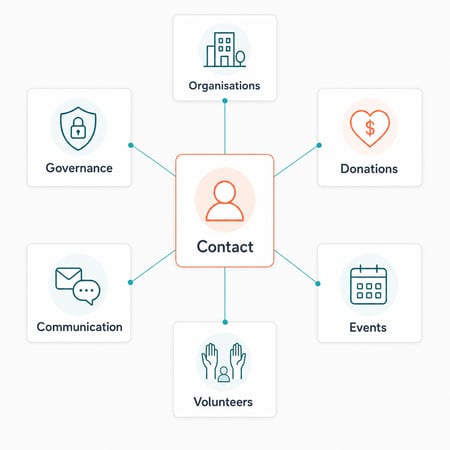
The exact structure should follow the NGO’s services and operating model. A fundraising charity and a social-service organisation will not need identical databases.
Which fields should an NGO CRM contain?
Start with a small core set. Add a field only when it supports a defined workflow, report, decision or legal requirement.
1. Identity and contact
- Full name and preferred name
- Email address and telephone number
- Preferred language and communication channel
- Organisation and role, when relevant
2. Relationship and fundraising
- Stakeholder type, such as donor, volunteer or member
- Relationship status and assigned staff owner
- Donation, membership, event or volunteer history
- Campaign, appeal or programme association
3. Communication and marketing
- Subscription or marketing status
- Permitted communication channels
- Consent or indication-of-no-objection record, where applicable
- Opt-out date, source and scope
4. Data governance and migration
- Original collection source and collection date
- Collection purpose or permitted use
- Legacy system ID and migration batch
- Data owner, access level and next review date
- Duplicate, incomplete or cleanup status
-1.png?width=900&height=308&name=VM%20BLOG%20BANNER%20(11)-1.png)
What should stay outside the general CRM?
Centralisation does not mean putting every document and sensitive detail into one database. Information should be excluded or stored in a more restricted system when the general CRM does not need it.
- Detailed beneficiary or case notes
- Medical, counselling or safeguarding information
- Copies of identity documents unless clearly required
- Banking details and full payment-card information
- Unstructured staff comments with no defined operational purpose
The CRM can often store a relationship status, case reference or next action without holding the underlying sensitive file.
What should you clean before migration?
Do not migrate every spreadsheet unchanged. Before importing data, work through these decisions:
- Identify the authoritative source for each type of information.
- Merge duplicate people without losing their donation or activity history.
- Standardise field names, formats and dropdown values.
- Separate confirmed marketing status from unknown or unreliable values.
- Remove obsolete fields and records that no longer serve a defined purpose.
- Assign an owner and review rule to every field that remains.
How does PDPO affect CRM design?
Hong Kong’s Data Protection Principles cover matters including collection, accuracy, retention, use, security, transparency, access and correction. In practical CRM terms, an NGO should be able to explain why a field exists, where its value came from, who may use it, how it is kept accurate and when it should be reviewed or removed.
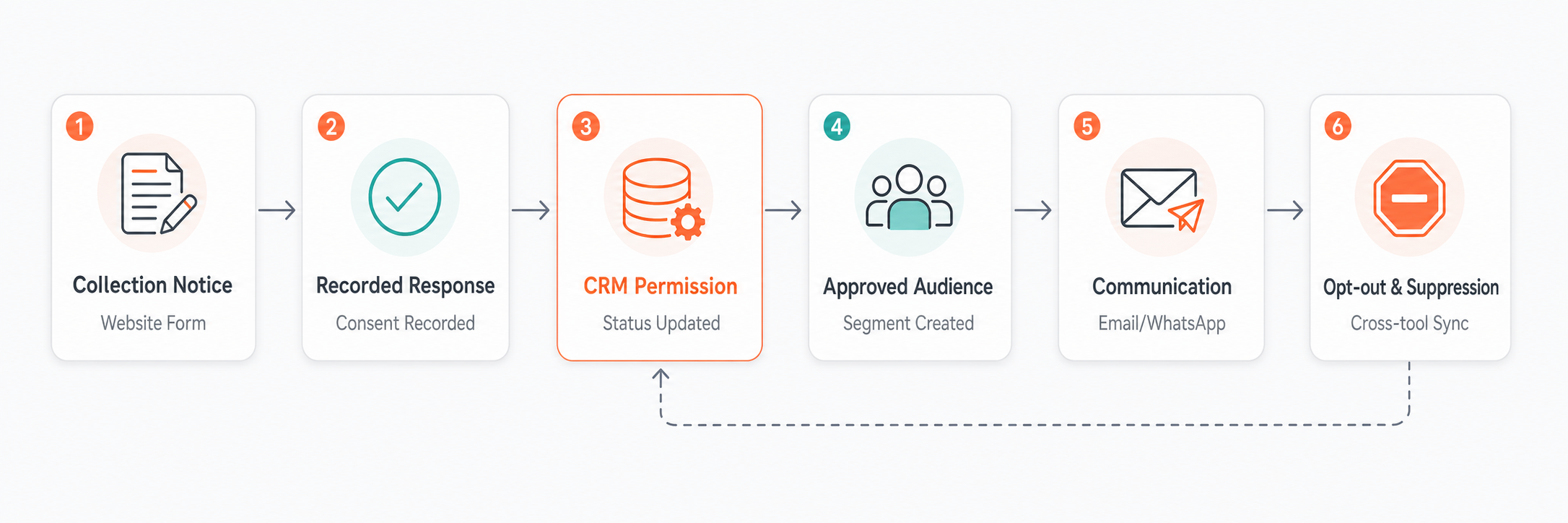
Fundraising messages may also fall within the direct-marketing regime. The CRM therefore needs a reliable way to record the relevant notification, response, permitted use and opt-out—not merely a single unchecked “consent” box.
See the PCPD’s overview of the Personal Data (Privacy) Ordinance and Guidance on Direct Marketing for the formal requirements.
How should Hong Kong NGOs think about AI and PDPO?
For Hong Kong NGOs, the issue is not whether AI should be used at all, but whether it is used inside a governed environment with clear controls over data access, model training and sensitive information. Staff should not paste donor or beneficiary information into uncontrolled public AI tools simply because the tool is convenient.
HubSpot’s AI settings allow Super Admins to manage whether AI can access CRM data, customer conversation data and files data. They can also turn off AI model training at account level while continuing to use AI features. Accounts with HubSpot Sensitive Data enabled are opted out of AI model training by default and cannot opt in while that setting is enabled.
HubSpot also states that third-party AI service providers engaged to deliver its subscription services are not permitted to use customer data for model training, with data retention minimized and zero retention used where possible. These controls create a more governable foundation than ad hoc use of consumer AI tools, but they do not make an NGO automatically PDPO-compliant.
Compliance still depends on what data the NGO collects, what users and AI features can access, what is shared with service providers, and how permissions, retention and internal policies are managed. The safer approach is to begin with approved use cases, minimum necessary data and documented human oversight.
-1.png?width=1000&height=533&name=VM%20BLOG%20BANNER%20(10)-1.png)
Use a lightweight data dictionary
Before configuring or migrating the CRM, create one row for every proposed field and record:
- Field name and business definition
- Example value and accepted format
- Required, optional or restricted status
- Source system and business owner
- Who can view or edit it
- Migration, review and retention rule
If nobody can explain how a property will be used or maintained, it probably should not be migrated yet.
Where does HubSpot fit for Hong Kong NGOs?
HubSpot can be configured as the central relationship database for donors, volunteers, members, corporate partners and event participants. Custom properties can reflect the NGO’s field definitions, while connected records and workflows can support follow-up, segmentation and reporting.
The important step is to design the data model and operating rules before configuration. HubSpot does not decide what an NGO should collect, who should access it or how long it should be retained. Explore HubSpot for NGOs in Hong Kong for a practical implementation framework.