
An Open Day may attract a strong number of registrations, but that figure alone does not tell school management whether the event supported admissions. For many international and private schools in Hong Kong, registration forms, attendance lists and formal application records are held separately. The team may know how many families registered, yet still be unable to say how many attendees later submitted an application.
The solution is not another spreadsheet comparing names after each event. A connected admissions CRM links each family’s registration, attendance, follow-up and application status to the same journey. This gives the admissions team a continuous view and allows management to measure Open Day performance using application outcomes rather than registration numbers alone.
Why Are Open Day Registration Numbers Not Enough?
Registration numbers are useful for planning venue capacity, staffing and event communications. They measure initial interest, but they do not show whether an Open Day contributed to the school’s application pipeline.
Management needs to distinguish between three separate figures:
- Families who registered
- Families who attended
- Families who later submitted an application
When these records are stored separately, the admissions team may have to compare names and email addresses manually. Matching becomes less reliable when one parent registers for the event but another submits the application, or when families use different contact details at different stages.
Connecting these stages does not prove that the Open Day alone caused a family to apply. It does, however, give management a consistent way to compare events and understand how many participating families progressed to a formal application.
Where Does the Tracking Connection Break?
The problem usually begins because each stage serves a different operational purpose. The registration form collects event details, the attendance list helps staff manage the day, and the application system handles the formal admissions process. Each tool may work correctly on its own while leaving no reliable connection between them.
After the event, admissions staff may export a registration list, update attendance in a spreadsheet and later compare it with new applications. This creates several practical difficulties:
- Family information may be entered differently in each system.
- A different parent may complete the application.
- Attendance updates may remain in a separate spreadsheet.
- Follow-up emails and calls may not be visible to the whole team.
- Each new Open Day creates another list that must be reconciled.
The result is not necessarily a lack of data. The school may already hold all the required information, but it cannot easily connect that information into one continuous admissions journey.
What Should a Trackable Open Day Journey Look Like?
A trackable journey does not require the school to place every admissions activity in one system. It requires each stage to be connected to the same prospective family or applicant.
A practical journey may include four stages:
- Registration: The school records the family, prospective student, preferred year group, intended entry year and the relevant Open Day.
- Attendance: The registration is updated as attended, did not attend or cancelled, rather than being stored in a separate final attendance list.
- Follow-up: The admissions team can see who owns the next action, what communication has already taken place and whether the family requested further information or a private visit.
- Application: When a formal application is submitted, its status is linked or updated against the existing family or applicant record.
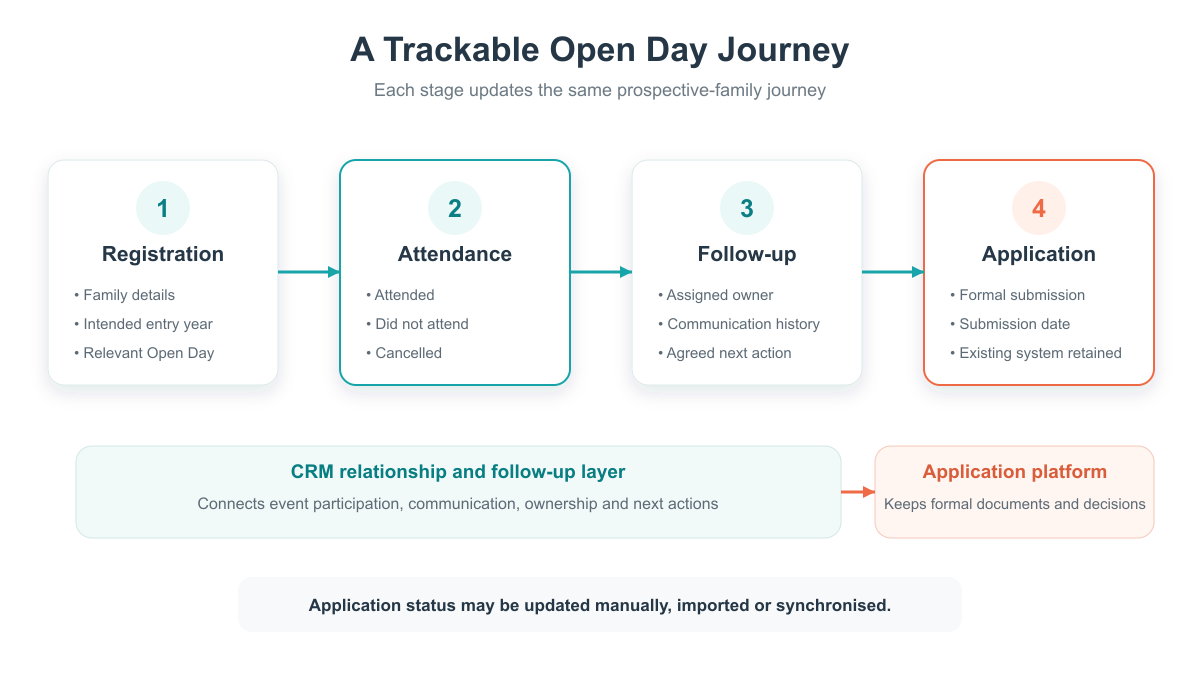
This creates a measurable path from registration to application while allowing the school’s existing admissions or application platform to continue handling the formal process.
What Connects the Journey Between an Open Day and an Application?
A school may already have one tool for event registration and another for formal applications. What is often missing is a system that follows the prospective family between those two points.
This is the role of a customer relationship management system, or CRM. A CRM keeps the family’s details, event participation, communication history and next actions connected, giving the admissions team a shared view before a formal application is submitted.
HubSpot is one CRM platform that can be configured for this purpose. An Open Day registration can create or update a contact record, while attendance and follow-up can be added to the same journey. When the family submits an application, the relevant status can be updated manually, imported from a spreadsheet or synchronised from the school’s application system.
.png?width=900&height=480&name=VM%20BLOG%20BANNER%20(35).png)
With these stages connected, the school can report on progression from registration to attendance and from attendance to application, instead of comparing separate lists after every event. The precise automation and reporting options will depend on the school’s existing systems and HubSpot subscription.
What Should School Management Measure?
The most useful Open Day report should go beyond the number of registrations. It should show how families progressed after expressing their initial interest.
Management can begin with four questions:
- How many families registered for each Open Day?
- What percentage of those families attended?
- How many attendees later submitted an application?
- How did the application conversion rate compare across different Open Days?
.png?width=900&height=480&name=VM%20BLOG%20BANNER%20(37).png)
Schools may also compare results by intended entry year, year group or original enquiry source when those details are recorded consistently. This can help management understand whether an event attracted the families the school intended to reach, rather than evaluating performance by overall volume alone.
Follow-up activity provides additional context. If one event generated strong attendance but few applications, the school can review whether families received timely communication, whether admissions tasks were completed and where interest appeared to decline.
Open Day Reporting Is Only One Part of a Connected Admissions CRM
The same problem can appear at other points in the prospective-family journey. Enquiries may arrive through different channels, private school tours may be recorded separately, and communication history may remain in individual staff inboxes.
A connected admissions CRM can also help a school:
- Keep new enquiries in one shared view
- Assign an owner and next action to each prospective family
- Track private visits, interviews and follow-up activity
- Preserve communication history when responsibilities change
- Give management a clearer view of progression towards application
This does not mean that every student record or admissions document must move into the CRM. The school’s application platform or SIS can continue to manage formal applications, documents and enrolled-student information. The CRM supports the relationship and follow-up journey that happens around those systems.
Open Day reporting is therefore one practical example of a wider issue: whether the school can connect prospective-family activity across teams and systems well enough to act on it and measure the outcome.
Where Should a School Begin?
A school does not need to replace its existing admissions systems or redesign every process at once. The first step is to identify one journey where information becomes disconnected and define what management needs to see.
For an Open Day, this means agreeing how registrations, attendance and applications will be identified and connected. The school can then determine which information should be captured in the CRM, which system remains responsible for the formal application, and how updates should move between them.
The same approach can later be applied to enquiries, private visits, admissions follow-up and other prospective-family interactions.
Virtue Media helps international and private schools in Hong Kong assess where disconnected data is affecting admissions communication, team follow-up and management reporting. Contact us to discuss how HubSpot could fit alongside your school’s existing systems and support a more connected admissions journey.