

Ask a Hong Kong NGO where fundraising really goes wrong, and you rarely hear "we can't find grants." You hear something more painful: we found the grant too late, or we found it in time and still lost, because we couldn't assemble the evidence fast enough.
Those are two different problems — a discovery problem and an evidence problem — and most NGOs try to solve both with the same exhausted development officer at 11pm.
This is where two Microsoft Copilot AI agents change the picture. Not because either is magic on its own, but because together they cover the full path from "which grant should we go for?" to "here is the proof we deliver." And when both feed into a CRM, that path stops being a scramble and becomes a pipeline you can actually manage.
This is one half of our digital transformation series for Hong Kong NGOs. The other half — the receipts, donor data and volunteer admin that eat your week — is covered in our companion post on AI agents for NGO daily operations.
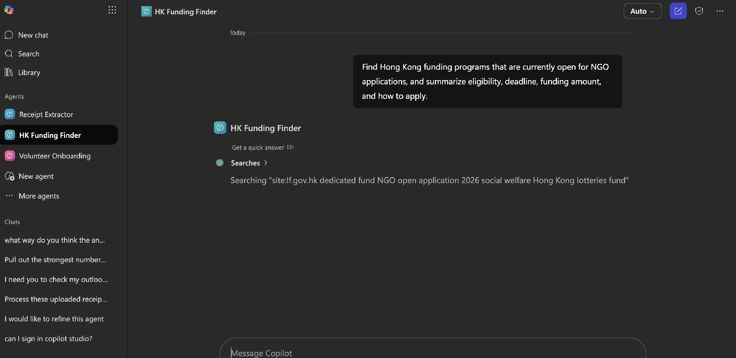
The agents live right inside Microsoft 365 Copilot — staff open them from the same sidebar they already use for chat.
In this Article
- Meet The Two Copilot Agens
- The workflow: from open grant to submitted application
- Step 1 — Find the opportunity (HK Funding Finder)
- Step 2 — Build the evidence (Annual Report Analyst)
- Step 3 — Match the evidence to the funder
- Why AI agents need CRM to matter
Meets The Two Copilot Agents
HK Funding Finder answers where should we apply? It surfaces open funding programmes from Hong Kong government and private sources, identifies which grants your organisation is eligible for, and summarises criteria, required documents, deadlines and amounts.
Annual Report Analyst answers why should they pick us? It reads your annual reports and pulls out the funding-relevant signals — scale, measurable outcomes, risks, credibility — and turns them into an evidence-backed grant-readiness analysis.
One finds the opportunity. The other builds the case. Run them in sequence and you have a repeatable fundraising workflow.
The workflow: from open grant to submitted application
Step 1 — Find the opportunity (HK Funding Finder)
Instead of one staff member manually monitoring scattered funding pages, you ask the agent once: find Hong Kong funding programmes currently open for NGO applications, and summarise eligibility, deadline, funding amount, and how to apply.
It reasons across public sources and returns a shortlist of best-fit, currently-open programmes — with the details that decide whether you're even eligible.
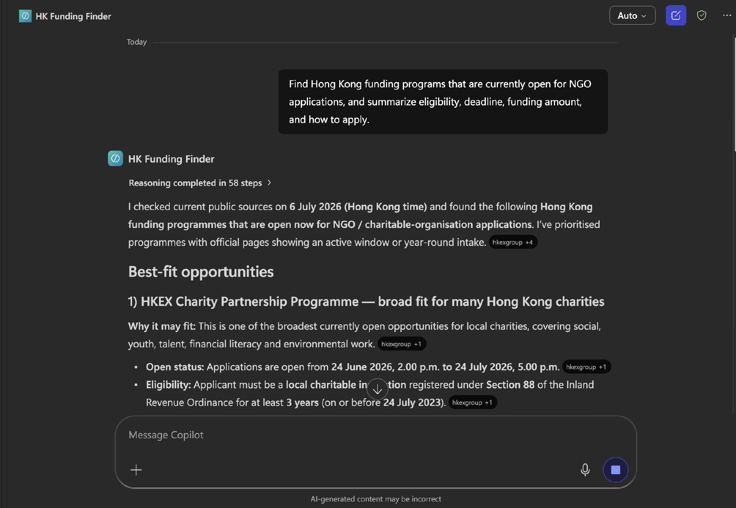 A real run: the agent surfaces the HKEX Charity Partnership Programme with its exact application window and the Section 88 eligibility requirement spelled out — the two facts that usually get discovered too late.
Into HubSpot: Create each viable opportunity as a Deal in a dedicated Grants pipeline. Set the Amount to the funding available and the Close Date to the application deadline. The moment you do this, two things happen: the deadline is no longer trapped in someone's inbox, and your board can finally see the fundraising pipeline as a forecast rather than a hope.
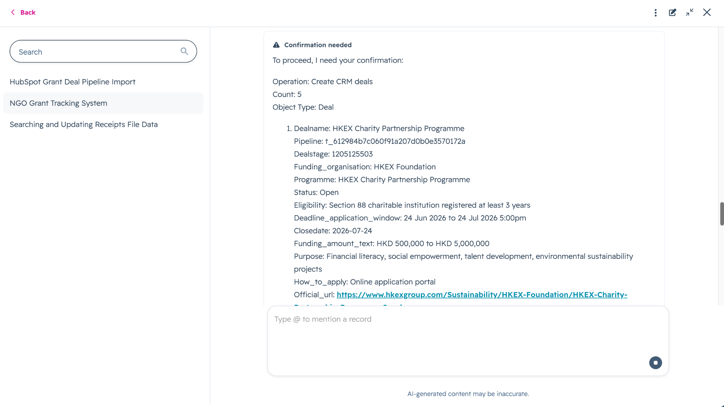
Step 2 — Build the evidence (Annual Report Analyst)
A shortlist is worthless if you can't back up the application. So before writing a word, point the second agent at your own annual reports and ask what your strongest funding evidence actually is.
It returns the numbers that matter to a funder — multi-year reach, measurable outcomes, delivery capability, institutional credibility — with each figure traced back to the source report.
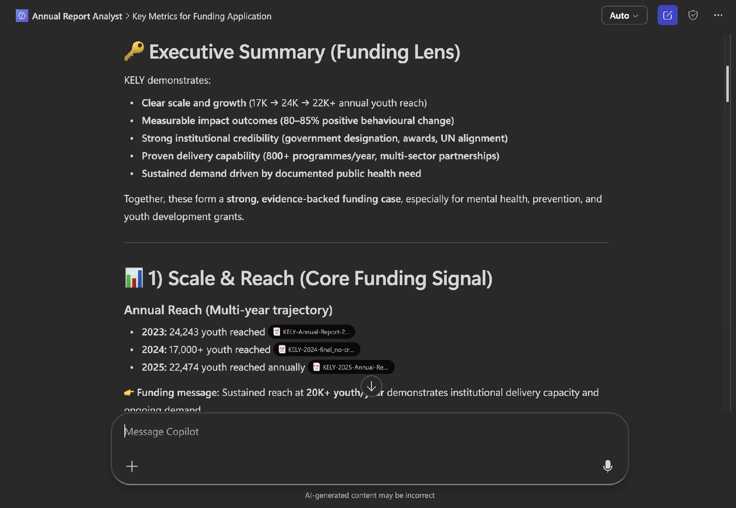
The Analyst turns years of annual reports into a funding case: sustained scale, measurable behavioural-change outcomes, and proven delivery capacity — each figure traceable to the source PDF, so nothing goes into an application unverified.
Into HubSpot: Attach the Analyst's output to the Deal — and attach the supporting documents with it. Grant approval is not a single moment; it's a process that runs from submission through screening, review and decision, and typically takes 1–6 months (government grants commonly 3–6 months from deadline to notification, private foundations 1–4).
Across that window, reviewers come back asking for clarifications and further documents, and the same core evidence gets requested again and again: your Section 88 tax-exemption letter, registration certificate, Memorandum & Articles of Association, audited financials, annual activity reports. Most NGOs keep these scattered across drives, inboxes and someone's laptop — so every request becomes a hunt, and a slow response is one of the most common reasons an application stalls or fails screening outright.
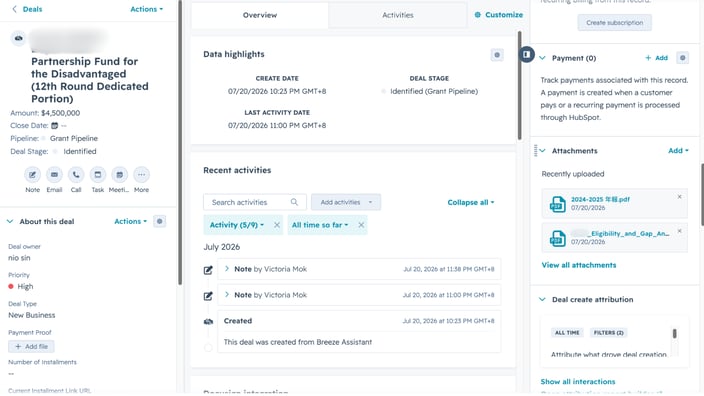
Storing all of it against the Deal, with your recurring proof-points (annual reach, outcome rates, delivery capacity) as custom properties on the organisation record, turns that hunt into a lookup. Assemble the evidence once and it becomes reusable institutional memory — ready for the next document request, the next resubmission, and the next funder who asks for the very same file.
Step 3 — Match the evidence to the funder
This is where the pair earns its keep. The Funding Finder knows what this specific funder assesses. The Analyst knows what you can prove. Put them side by side and the application writes itself around the overlap.
Ask the Funding Finder how to prepare a strong application and it coaches the submission directly — showing you the difference between a vague problem statement and the specific, evidence-backed version funders reward.
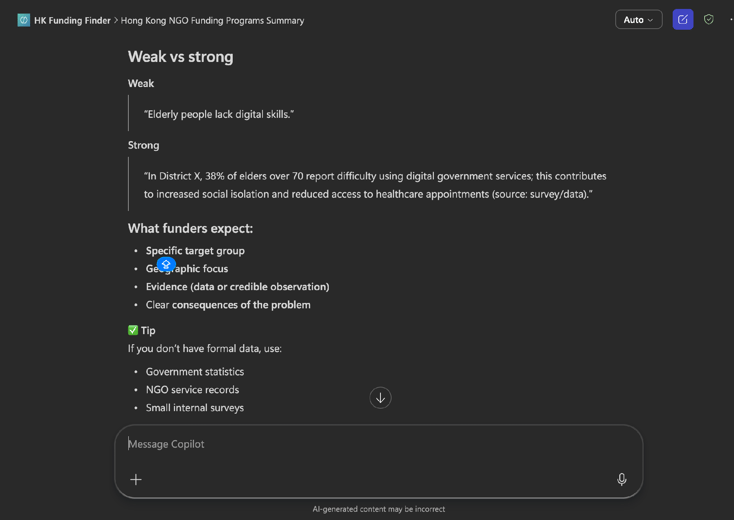
"Elderly people lack digital skills" is a weak claim. The same claim with a target group, a district, a percentage and a consequence is a fundable one — and Step 2 is where you got the numbers to write it.
Into HubSpot: Log the match as a note or task on the Deal: which of your proof-points map to which funder criteria. If the bid succeeds, you know exactly which evidence worked. If it fails, you know what was missing. Either way, the next application starts smarter than the last.
Why AI Agents need CRM to matter
Run these two agents without a CRM and you get better answers — living in a chat window that nobody else can see, forgotten by the next submission.
The agents generate intelligence. HubSpot is what turns intelligence into a system:
- The Funding Finder's shortlist becomes a pipeline with deadlines, visible to your whole team and your board.
- The Annual Report Analyst's proof-points become reusable properties, not a document someone rebuilds every time.
- Every won and lost bid becomes data — so next year you apply to the right funders with the arguments that actually work.
That's the difference between an NGO that uses AI and an NGO that has been transformed by it. See how we set this up in HubSpot CRM for NGOs.
Turn your grant scramble into a pipeline
Finding grants is a research problem. Winning them, repeatedly, is a systems problem — and that's what HubSpot CRM for NGOs solves. One pipeline for every opportunity, one place for the evidence that wins them, and a record of what worked so your team gets better with every submission.
As a HubSpot Platinum Partner in Hong Kong, we help NGOs set up both halves: the Copilot agents that do the research, and the HubSpot CRM that makes the results last.
Book a free HubSpot CRM consultation for your NGO →